

Cat portrait from photo: Everything you need to know before you order


Cats are famously difficult to photograph well. They blink at the wrong moment, turn away just as the light is perfect, or sit magnificently still for exactly three seconds before deciding they have somewhere more important to be.
And then, occasionally, without warning, they do something extraordinary. They find a patch of afternoon sunlight, settle into it with the air of someone who has always owned this particular corner of the world, and look directly into the camera with an expression that belongs in a gallery.
That photo deserves better than a camera roll. A cat portrait from photo takes that image and gives it permanent form, a piece of original artwork, created by a skilled artist, that captures your cat with a warmth and a character that a printed photograph rarely achieves on its own.
This blog covers everything you need to know before ordering: why cats make such compelling portrait subjects, which styles suit different personalities and breeds, what kind of photo you need, and how Portrait My Pet handles the process from submission to delivery. So keep reading.
Why cats make particularly compelling portrait subjects?
Cats make compelling portrait subjects because their faces are unusually expressive, their coat patterns are extraordinarily varied, and their personality is often most visible in a moment that a camera barely catches.
Unlike dogs, who tend to broadcast their feelings openly and consistently, cats are more selective about when they reveal themselves. A cat in full personality, curious, imperious, playful, deeply suspicious of a cardboard box, is a particular kind of subject. Getting that quality into a photograph requires luck as much as skill. Getting it into a portrait requires an artist who has the time to study the photo carefully and make deliberate decisions about expression, light, and detail.
The variety of cat faces alone makes portraiture interesting. The broad, flat face of a Persian is a completely different challenge from the angular structure of a Siamese or the wild, spotted pattern of a Bengal. Long-haired breeds carry their identity in the texture and volume of their coats. Short-haired breeds carry it in the precision of their markings and the sharpness of their features. Each requires a different approach, and a good portrait artist understands that a cat portrait is not a generic exercise but a specific study of a specific animal.
This is also why a well-executed cat portrait can feel more like your cat than the photograph it was made from. An artist has the time and the intention to look at the photo closely and decide what matters most about this particular face. That decision, which details to emphasize, how to render the eyes, how to handle the light on the coat, is what produces something that makes a cat owner look at the finished portrait and feel their cat looking back at them.
The most popular cat portrait style, and which suits your cat!
The style you choose shapes everything about the finished portrait, how it looks on a wall, what it says about your cat, and whether it feels right when you open the proof. Here is a practical guide to the most popular options and the cats they tend to suit best.
1- Royal and Renaissance cat portraits
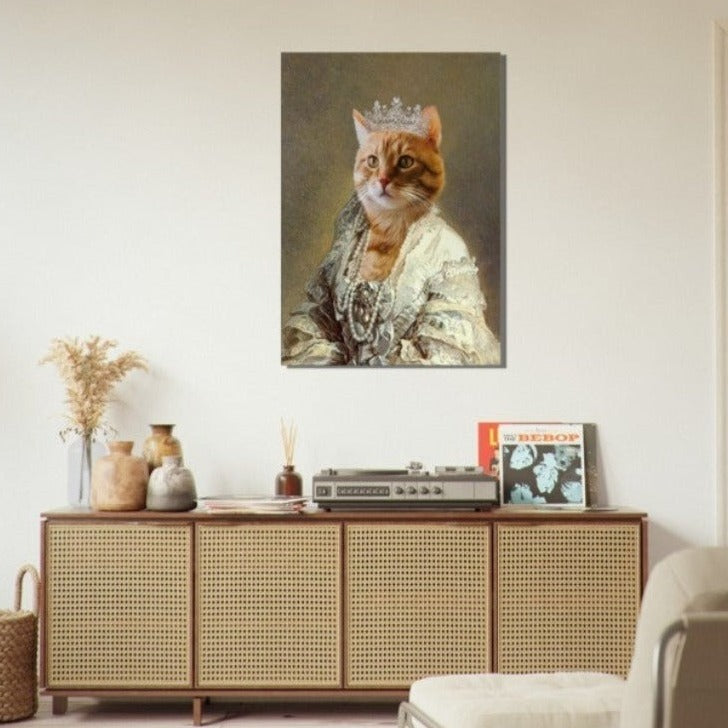
Cats already carry themselves as though they are in charge of every room they occupy. A royal or Renaissance-style portrait simply makes that official. Your cat is placed in period attire, velvet robes, a crown, a lace collar, and a formal composition, and the result is both deeply funny and oddly accurate.
This style works particularly well for cats with strong facial structure, dense coats, and a natural air of authority. Persians, Maine Coons, British Shorthairs, and Ragdolls tend to suit it exceptionally well; their faces have the weight and gravity that period portraiture calls for. It is also a style that works brilliantly in living rooms, where it functions as both a statement piece and a conversation starter. Portrait My Pet's royal portrait collection covers the full range of regal compositions.

2- Watercolor cat portraits
Watercolor is a natural match for cats. The softness of the palette, the fluid quality of the paint, the way color bleeds gently from one area to another, all of this suits the particular delicacy of a cat's face, especially in lighter-coated breeds.
Siamese cats, with their color-pointed coats and pale bodies, translate beautifully into watercolor. Abyssinians, with their warm, ticked coats and fine features, suit the medium equally well. White or cream cats often look extraordinary in a watercolor portrait, where the subtle shading that defines their form can be handled with precision and gentleness that a bolder medium might lose.
From a décor perspective, watercolor cat portraits suit bedrooms, reading rooms, and light-filled spaces where the artwork needs to feel warm and personal rather than bold and declarative.
3- Funny and costume cat portraits
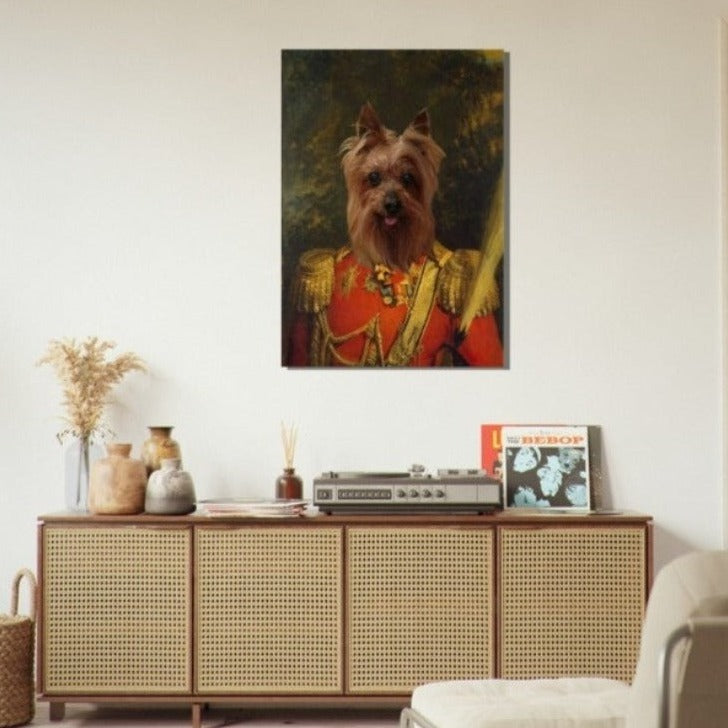
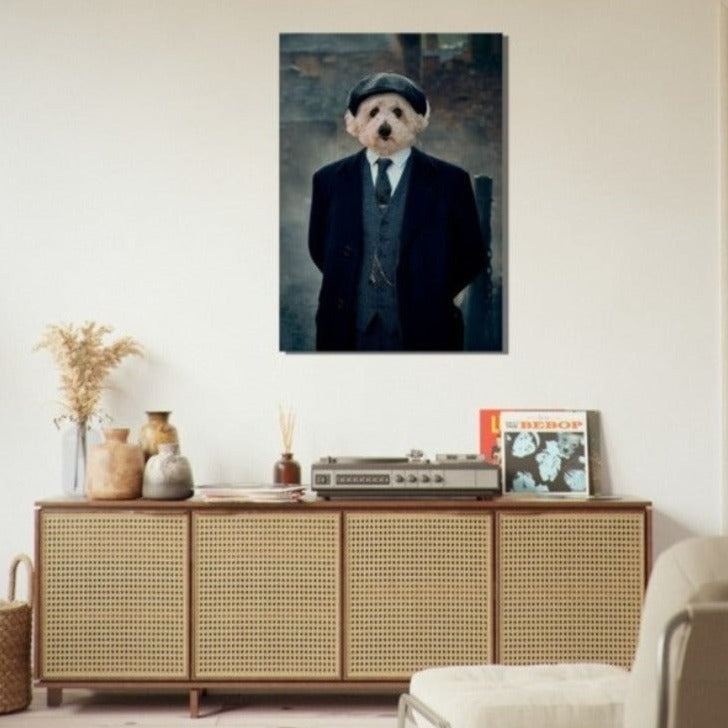
There is an inherent absurdity to cats that makes costume portraits feel less like invention and more like honest reportage. A cat dressed as a Victorian general, seated with an expression of mild contempt for the entire world, is not an exaggeration; it is a fairly accurate summary of how most cats conduct themselves daily.
For cat owners who describe their cat's personality in very specific human terms, who is certain their cat is judging them, plotting something, or simply deeply unimpressed with the standards of the household, a funny or costume portrait is the most truthful option available. These work brilliantly in kitchens and hallways, and they are reliably the piece in the home that guests ask about first.
Browse Portrait My Pet's funny portrait collection for the full range of themes.
4- Illustrated and artistic cat portraits
Portrait My Pet's artwork portrait collection covers styles that sit between strict realism and full costume themes, rich, detailed, beautifully composed illustrations, where the artistic interpretation is part of the point. These portraits capture the cat's coloring, expression, and character within an original artistic context, and the results tend to have a painterly quality that works well in dining rooms, studies, and spaces where art is displayed with some intention.
These styles are particularly well-suited to cats with complex or beautiful coloring, Bengals, tortoiseshells, and silver tabbies, where the natural patterning of the coat is itself an artistic subject worth rendering carefully.
5- Minimalist line art portraits
For cats with a clean, graphic quality, black and white cats, cats with strong silhouettes, sleek-coated breeds like the Oriental Shorthair or the Devon Rex, a minimalist line art portrait can be the most striking option of all.
A single continuous-line portrait of a cat, elegantly framed in a simple black or white frame, reads as intentional and design-led. It suits contemporary interiors, minimal apartments, and spaces where every element has been considered, and a novelty print would look out of place. It is also frequently the style that prompts the question "Where did you get that?" from guests who don't immediately register it as a pet portrait.
Important Considerations for a cat portrait from photo
Every cat breed has specific visual characteristics that affect how a portrait should be approached. A one-size-fits-all method produces portraits that look like cats. A breed-aware approach produces portraits that look like your specific cat. Here is what matters by breed group.
Long-haired breeds: Persians, Maine Coons, and Ragdolls
The defining characteristic of long-haired cats is their coat, and a portrait that doesn't do justice to the coat has missed what makes the breed itself. The layering and volume of a Maine Coon's fur, the dense, face-framing ruff of a Persian, the silky, flowing coat of a Ragdoll; these are the visual signatures of these breeds, and they require careful, patient rendering from an artist.
For long-haired cats, the ideal reference photo is one taken in natural light that allows the texture and layering of the coat to be clearly seen. A photo taken in direct flash tends to flatten the fur and lose the depth that distinguishes a long-haired portrait from a generic one. Close enough to show the individual fur layers, but far enough to see the full shape of the head and the way the coat falls around the face.
Short-haired and sleek breeds: Siamese, Bengal, British Shorthair, and Abyssinian
With short-haired breeds, the coat carries less of the visual weight, and the face, its structure, its markings, and its expression become the primary subject. This raises the stakes for accuracy considerably.
Bengals are a particular case. Their coat patterns, rosettes, and marbling in rich, contrasting tones are not merely decorative; they are the breed's identity. A Bengal portrait where the rosette pattern is approximately right, rather than precisely right, is a portrait of a Bengal cat rather than a portrait of your Bengal cat. The same applies to Siamese color points: the exact distribution of darker color on the face, ears, paws, and tail is what makes a Siamese recognizable, and a portrait that handles this loosely loses the likeness at the most fundamental level.
Portrait My Pet's artists are experienced with breed-specific markings, and the proofing process exists precisely to catch and correct these details before anything is committed to print.
Cats with distinctive individual markings
Tabbies, tortoiseshells, calicos, and cats with specific facial markings, a perfectly symmetrical blaze, a distinctive patch over one eye, and an unusual facial coloring that makes the cat immediately recognizable are the cats whose owners are most acutely aware of accuracy. The markings are not decoration. They are the cat's face. They are how the owner knows it is their cat and not any other.
For these cats, the more clearly the markings are visible in the reference photo, the better the portrait will capture them. If the distinctive marking is partially in shadow or the angle of the photo doesn't show it clearly, mention it specifically in your order notes, and use the proofing stage to confirm it has been rendered accurately before approving the final print.
What makes a good reference photo for a cat portrait
The best reference photo for a cat portrait is a close-up taken in natural light, with both eyes visible and in sharp focus, showing the face clearly enough that the individual markings and features are readable. Everything else is secondary.
In practice, getting that photo from a cat requires a certain amount of patience and strategy.
Catching a cat when they are still
Cats are most cooperative immediately after waking from a sleep, after a meal, or when they have settled into a favourite spot and have no immediate reason to move. These are the windows. Have the camera ready and approach slowly. A phone camera works perfectly well; the issue is rarely the equipment; it is the timing.
Burst mode, the setting that captures a rapid sequence of shots while you hold the shutter button, is useful for cats that hold their pose only briefly. Take twenty frames in two seconds and choose the best one. It is also worth taking portraits at your cat's eye level rather than looking down at them, as the perspective produces a more natural and expressive result.
Getting the eyes right
The eyes are the heart of any cat portrait. They are also where the personality lives most visibly. A photo where both eyes are clearly visible, lit by natural light (not flash), and in sharp focus gives the artist the best possible foundation. If your cat tends to blink, take photos in a burst sequence and select the frame where both eyes are open and alert.
The catch light, the small reflection of light in the eye, is one of the details that makes a portrait feel alive rather than flat. It is produced by natural light and is almost impossible to replicate convincingly from a flash-lit photo. Whenever possible, photograph near a window or outdoors.
Lighting for different coat colors
Dark-coated cats, black cats, dark grey cats, and dark tortoiseshells are the hardest to photograph well. Camera sensors often struggle with very dark fur in low light, producing a flat, undifferentiated dark mass rather than the rich, nuanced coloring that the coat actually has. For dark cats, photograph outside on an overcast day, or near a large window with soft, diffused natural light. Avoid direct sunlight, which creates harsh highlights, and avoid artificial light, which tends to produce orange or yellow color casts.
White cats present the opposite problem: overexposure. The camera tries to compensate for the brightness and can wash out the subtle shading that defines the cat's form. Slightly underexposing a white cat photo, or photographing in softer, less direct light, tends to produce a more useful result for an artist.
What to do if your cat will not cooperate?
Some cats are not interested in being photographed under any circumstances. If you have tried everything and the available photos are all imperfect, do not despair. Portrait My Pet's team reviews every submitted photo before work begins and will advise you honestly if the image is going to cause problems. They are experienced in working with less-than-ideal reference material, and many strong portraits have been made from photos the owner initially thought were not good enough.
If you have multiple photos, even several imperfect ones showing different angles, expressions, or markings, submit them all. An artist who can cross-reference several images has far more to work with than one who has only a single ambiguous shot. You can also reach out via Portrait My Pet's live chat before placing your order if you want an honest assessment of what you have.
How does Portrait My Pet create a cat portrait from your photo?
The process at Portrait My Pet is designed to produce a portrait that looks like your cat, specifically, unmistakably your cat, before anything is ever printed.
After you choose your style from their collection of more than 150 options and upload your photo, the team reviews the image before the artist starts work. If there are any concerns about the quality, angle, or lighting of the photo, they will contact you promptly and work with you to find a better alternative. This early review is one of the most practically important parts of the process; it means problems are caught at the beginning, not after the portrait has been completed.
Within as little as one day of placing your order, you receive a digital proof of your cat's portrait by email. This is not a rushed approximation; it is a fully realized version of the portrait that you review carefully against your reference photo. Check the eyes first. Then the markings. Then the coat color and texture. If anything is not right, a marking in the wrong position, an eye color that reads differently from how you see it, a whisker pattern that needs adjusting, you raise it here.
Unlimited revisions are included at no extra cost. For a cat portrait, where the specific markings and features often matter most to the owner, this is especially important. The portrait is refined until you are satisfied. Once you give your approval, the portrait goes to print on premium materials, canvas or framed poster, and ships to your door with all hanging materials included and free shipping.
Read what other cat owners have said on Portrait My Pet's reviews page before placing your order.
Cat portrait from photo as a gift
A significant number of cat portrait orders are placed as gifts, and for good reason. A portrait of someone's cat is, by definition, specific to them. There is no off-the-shelf version of this gift. It requires knowing the animal, finding or requesting a good photo, choosing a style that suits the recipient, and putting the effort in to make it right. That effort is obvious in the finished piece, and the person receiving it knows it.
For the photo, the most straightforward approach is to ask the cat owner to share their favorite photos with you under any casual pretext; you could say you're putting together a birthday collage, or simply that you've always wanted a good photo of their cat. Choose the clearest, most characterful image from what they send.
For the style, think about the recipient's personality and their home. A cat owner who talks about their cat's personality in very specific human terms will appreciate a funny or royal portrait. Someone with a carefully considered interior will respond better to a watercolor or line art print. If you are unsure about either the style or the timing, particularly if the portrait is a memorial gift, Portrait My Pet's gift card puts the choices in the recipient's hands, at a pace that suits them.
Questions you may think of
Can a cat portrait be made from a screenshot or a photo saved from social media?
It depends on the resolution of the image. Screenshots and images shared on social media are often compressed, which reduces the level of detail available to the artist. Portrait My Pet reviews every submitted photo before work begins and will let you know promptly if the resolution is too low to produce a strong portrait. If the only available image of your cat is a social media photo, it is worth submitting it and asking the team to assess it, some images retain enough detail to work well, particularly if they were taken with a modern phone camera and shared without heavy compression.
How are whiskers handled in a cat portrait?
Whiskers are one of the most distinctive features of a cat's face and are treated with care in Portrait My Pet's portraits. In illustrated and digital painting styles, whiskers are typically rendered as fine, precise lines that extend naturally from the cat's muzzle. The length, direction, and number of whiskers visible in your reference photo inform how the artist approaches them. If your cat has particularly prominent or unusual whiskers — very long, very dense, or asymmetrical- mention it in your order notes so the artist knows to pay specific attention to that detail.
Can I commission a portrait of two cats together in one image?
Yes. Portrait My Pet offers multi-pet compositions featuring two, three, and four animals in a single portrait. For a composition featuring two cats, it helps to submit a clear photo of each cat individually, ideally showing their face and markings clearly, rather than a single photo of both cats together, which often means one is partially obscured or at an angle that makes capturing the likeness difficult.
The artist will compose both cats within the chosen style, and you will review the combined composition in the digital proof before anything is printed.
My cat is mostly indoors and rarely photographed in good light. What should I do?
Most indoor cat photos are taken in artificial light, which tends to produce color casts and flatten the texture of the coat. The most practical solution is to photograph your cat on a bright day near a window; even a cloudy day provides soft, diffused natural light that produces better results than ceiling lighting or lamps. Place your cat near the window (cats usually find this arrangement entirely acceptable) and photograph from the side or slightly above to catch the light on their face. If natural window light is genuinely not possible, overhead lighting supplemented by a second light source positioned to one side produces a more three-dimensional result than overhead light alone.
Is a cat portrait suitable as a gift for someone who has recently adopted a new kitten?
It is one of the most thoughtful gifts you can give at that moment. The early weeks with a new kitten pass very quickly, and a portrait commissioned during that period, capturing the cat as they look in their first months, becomes something the owner treasures in a different way from a portrait of an adult cat. It marks the beginning of the relationship. If you are commissioning a kitten portrait as a gift, try to use a photo taken within the first few months, and choose a style that reflects the kitten's emerging personality rather than a formal or sedate composition. The funny and illustrated portrait styles tend to work particularly well for kittens, whose expressive faces and absurd dignity make them natural portrait subjects from a very young age.
At last you should remember that cats are not interchangeable. Every cat has a face, a set of markings, a personality, and a particular way of occupying a room that belongs only to them. A camera roll captures moments of all of this. A portrait captures the character behind the moments, the specific quality that makes your cat yours and no one else's.
Portrait My Pet's process is built to deliver exactly that: a portrait created from your photo, refined through the proofing stage until the likeness is right, and printed on quality materials that will hold their place on a wall for years.
When you're ready, browse the full Portrait My Pet collection and find the style that fits your cat. The right portrait is in there..






0 コメント